

Closing the gap between research and commercialisation: Insights from the 2025 AVPA Conference.
Nov 06, 2025
At this week's 2025 AVPA Conference, innovation leaders and investors from across Africa explored one of the continent’s biggest challenges: driving sustainable investments and innovations for resilient growth.
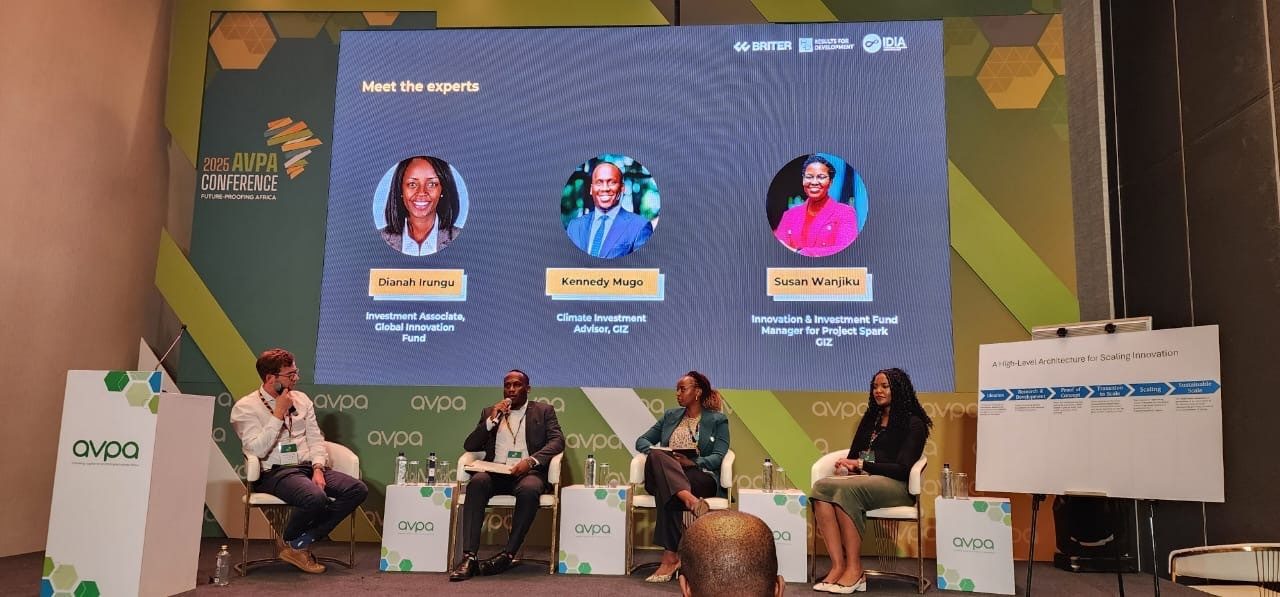
GIF Investment Associate, Dianah Irungu, joined a panel discussing how to bridge the research-to-commercialisation (R2C) funding gap, the stage between validated research and commercial adoption, where promising innovations often stall due to a lack of risk-appropriate capital and support to reach market viability.
The conversation focused on practical ways to de-risk early-stage innovation and attract private investment, particularly amid shrinking Official Development Assistance (ODA) and Development Finance Institution (DFI) budgets and reduced investor risk appetite. The panel explored where innovations tend to stall and how strategic deployment of public resources, through tools like blended finance, first-loss and catalytic capital, and funds-of-funds, can support homegrown talent on the pathway to scale. Drawing on lessons from South Africa’s Technology Innovation Agency, they highlighted the role of philanthropic and concessional funding in absorbing early-stage risk, balancing developmental impact with financial returns, and the critical role of governments in building ecosystems and creating investable pipelines.
Key takeaways
Scaling local innovation requires more than money
Funding alone does not scale innovation. Many promising ventures struggle to grow not because their ideas lack merit, but because the cost of producing and delivering their product or service is often higher than the revenue it generates, and because their teams may lack the operational, managerial, or strategic capacity needed to manage growth effectively.
These structural and operational foundations, including sound governance, financial management and market readiness, are essential for scaling. The key message is that public funding must be holistic, combining financial support with capability-building and ecosystem development. Only then can innovation become truly investment-ready.
Trusting local expertise and proving it
A recurring insight was that perception and evidence gaps remain major barriers to African innovation. Local ventures often lack the extensive data that investors expect, and are sometimes undervalued because they do not mirror familiar Western models.
Bridging this divide requires two shifts: investing in evidence generation, and building greater trust in local expertise and lived experience. Investors must recognise that impact in African contexts may look different, but can be equally powerful and scalable.
Catalytic capital as a confidence builder
Examples from our portfolio, such as Boomitra and Toothpick, show how catalytic capital can help early-stage ventures grow by taking on some of the initial risk. This can involve funding offered on more generous terms than usual, or money that covers early losses, allowing businesses to test and prove their ideas before commercial investors are willing to provide larger-scale investment.
By structuring public resources strategically through blended finance vehicles, governments and development agencies can help crowd in private capital and create a more predictable pathway from pilot to scale.
GIF’s Growth Fund illustrates this approach in practice. The fund addresses the financing gap many entrepreneurs face in emerging markets by providing smaller investments that meet ventures where they are, while helping build a pipeline for future commercial investors.
We’re showing that high-impact innovations can be investable, commercially sustainable and scalable. As a permanent-capital evergreen vehicle, the Growth Fund can continually raise and reinvest capital, including in local currencies, supporting ventures throughout their growth journey.
Aligning across the capital continuum
Better coordination between funders is essential. Many ventures fall into the R2C trap not because of weak performance, but because of misalignment between successive investors.
The solution lies in designing financial instruments that enable smooth transitions across stages of growth, from grants to concessional debt to equity, while supporting ventures to achieve the critical milestones required to unlock each subsequent round of funding. This approach ensures that ventures focus not just on surviving the next 18 to 24 months, but on building the foundations needed for sustainable growth and long-term scale.
Policy predictability matters as much as incentives
Investors are not only looking for financial returns, they are seeking stability and predictability. While tax incentives and innovation-friendly policies are valuable, they must be supported by transparent and consistent regulatory frameworks, as well as efforts to mitigate currency and political risks. Confidence in governance is, ultimately, a key driver of investment.
The path forward
The 2025 AVPA Conference discussions made one thing clear: Africa’s innovation potential is immense, but unlocking it requires a smarter blend of public strategy, private capital, and local insight. Public funding should not simply fill gaps, it should shape markets, reduce risk, and signal confidence in the continent’s capacity for innovation.
As global development finance budgets tighten and private investors become more cautious, the challenge is to ensure every public pound or dollar is catalytic. When used strategically, public capital does more than fund innovation, it builds ecosystems that allow innovation to thrive.